Last updated: 2026-11-26
16. Groups and trees of boxes
For new readers
A model is a group of shapes, and a group of groups; this page opens groups (a transform shared by its children, normals carried back out through every level) and the bounding boxes that let a ray skip a whole group at once, up to a tree of boxes for meshes of thousands of triangles. The world uses the same boxes for its objects.
Groups
A group is a shape with no surface of its own: it is the shapes it holds, carried by one transformation. Nest groups and a transformation placed on the outermost one moves the whole tree. This page also asks for bounding boxes, so that a ray can skip a whole group it cannot touch.
Step 1 — shapes are values, so the parent link is attached on the way out
The book gives every shape a mutable parent pointer and builds trees by adding a
shape to a group that may already sit inside another group. Shapes here are
values: set_transform returns a new shape, and so does add_child. Two things
follow.
- A tree is built from the leaves up. A program that would add to an inner group after placing it in an outer one assembles them in the other order here; the tree is the same.
- There is no pointer to follow back up. Instead, when a group returns a child's
hit it appends itself, as the outermost ancestor, to that hit's object (as a
copy of the group without its children). A sphere found through
g2insideg1comes back assphere → g2 → g1, which is exactly the chain the book'sworld_to_objectandnormal_to_worldwalk. A shape's identity is itsid, so "the hit iss2" is checked by id.
A group's intersection is every child's intersections, merged and sorted by t.
The group's own transformation is applied by intersect, as for any shape, so the
children see the ray in group space.
make a function called intersect takes s, r returns xs
  if s[8] then
    return local_intersect(s, r)
  end
  return local_intersect(s, transform_ray(r, s[2]))
end

# a point from world space to the shape's object space, through every group
# between the two (the outermost first)
make a function called world_to_object takes s, p returns q
  let q = p
  if s[7] != false then
    let q = world_to_object(s[7], p)
  end
  if s[8] then
    return q
  end
  return mat_tuple(s[2], q)
end

# a normal from object space to world space: this shape's normal matrix, then
# each enclosing group's in turn
make a function called normal_to_world takes s, n returns w
  let w = normalize(n)
  if not s[8] then
    let nv = mat_vec([get_x(n), get_y(n), get_z(n)])
    let rows = s[4]
    let w = normalize(vector(ga_vec_dot(rows[0], nv), ga_vec_dot(rows[1], nv), ga_vec_dot(rows[2], nv)))
  end
  if s[7] != false then
    let w = normal_to_world(s[7], w)
  end
  return w
end

make a function called normal_at takes s, world_point returns n
  return normal_at_hit(s, world_point, false)
end

# a sphere with a glassy material: transparency 1, refractive index 1.5
make a function called glass_sphere returns s
  return set_material(sphere(), with_refractive_index(with_transparency(material(), 1), (3/2)))
end
normal_at is now the book's three steps: point to object space through the
parents, the shape's own local_normal_at, and the normal back out through the
parents. A normal is carried by the cofactor matrix of each level's 3×3 part (the
dual of the tangent plane, as in Light at a point, and shadows), and pattern_at_shape uses
world_to_object too, so stripes and checkers on a grouped shape follow the
group.dual matrix: normal transforms
make a function called group returns g
  return new_shape("group")
end

make a function called group_children takes g returns kids
  return g[6][0]
end

make a function called is_empty_group takes g returns b
  return g[6][0].length == 0
end

make a function called shape_parent takes s returns p
  return s[7]
end

# the group without its children: all that a hit needs to remember of it
make a function called group_frame takes g returns f
  return list_set(list_set(g, 6, [[], false]), 7, false)
end

# a copy of the shape whose outermost ancestor is `frame`
make a function called attach_outer takes s, frame returns s2
  if s[7] == false then
    return list_set(s, 7, frame)
  end
  return list_set(s, 7, attach_outer(s[7], frame))
end
Step 2 — bounding boxes
Each group keeps the box that holds its children, in its own space, updated by
add_child. A child's box is moved into the parent's space by sending all eight
corners through the child's matrix and taking the box of the results (a turned
box needs all eight). A shape with an infinite side, a plane or an untruncated
cylinder, becomes all of space when transformed, since an infinite coordinate times
a zero matrix entry is not a number; such a group simply never culls.
The ray test is the cube's slab test with the faces moved: the face of axis i at
c is the plane vector π = eᵢ + c e∞, and the ray meets it at the usual
t = −(O·π)/(d·π). For a point O (with O·e∞ = −1) that is (c − oᵢ)/dᵢ, read
straight off the multivector, since this test runs at every group of every ray.
Where the cube treats a ray lying in a face plane as a miss, the box test counts
it as a hit: a box that culls must never lose a hit, and a tangent child can touch
the face.
# the built-in min and max return floats; bounds stay exact
make a function called num_min takes a, b returns v
  if b < a then
    return b
  end
  return a
end

make a function called num_max takes a, b returns v
  if b > a then
    return b
  end
  return a
end

make a function called is_finite takes v returns b
  return abs(v) < infinity()
end

make a function called whole_space returns b
  let inf = infinity()
  return [[0 - inf, 0 - inf, 0 - inf], [inf, inf, inf]]
end

# the bounds of a shape in its OWN space
make a function called shape_bounds takes s returns b
  let kind = s[5]
  if kind == "plane" then
    let inf = infinity()
    return [[0 - inf, 0, 0 - inf], [inf, 0, inf]]
  end
  if kind == "cylinder" then
    return [[-1, s[6][0], -1], [1, s[6][1], 1]]
  end
  if kind == "cone" then
    let r = num_max(abs(s[6][0]), abs(s[6][1]))
    return [[0 - r, s[6][0], 0 - r], [r, s[6][1], r]]
  end
  if kind == "triangle" or kind == "smooth_triangle" then
    return triangle_bounds(s)
  end
  if kind == "group" then
    return s[6][1]
  end
  if kind == "csg" then
    return s[6][3]
  end
  if kind == "torus" then
    return torus_bounds(s)
  end
  if kind == "implicit" or kind == "function" then
    return s[6][1]
  end
  return [[-1, -1, -1], [1, 1, 1]]
end

# the smallest box holding the eight corners of box b sent through matrix m; a box
# with an infinite side is replaced by all of space (an infinite coordinate times a
# zero matrix entry is not a number)
make a function called transform_bounds takes m, b returns b2
  let lo = [0, 0, 0]
  let hi = [0, 0, 0]
  let first = true
  let ix = 0
  while ix < 2 do
    let iy = 0
    while iy < 2 do
      let iz = 0
      while iz < 2 do
        let x = b[ix][0]
        let y = b[iy][1]
        let z = b[iz][2]
        if not (is_finite(x) and is_finite(y) and is_finite(z)) then
          return whole_space()
        end
        let q = mat_tuple(m, point(x, y, z))
        let c = [get_x(q), get_y(q), get_z(q)]
        let k = 0
        while k < 3 do
          if first or c[k] < lo[k] then
            let lo = list_set(lo, k, c[k])
          end
          if first or c[k] > hi[k] then
            let hi = list_set(hi, k, c[k])
          end
          let k = k + 1
        end
        let first = false
        let iz = iz + 1
      end
      let iy = iy + 1
    end
    let ix = ix + 1
  end
  return [lo, hi]
end

# a child's bounds in its parent's space (false for an empty group)
make a function called parent_space_bounds takes s returns b
  let b = shape_bounds(s)
  if b == false then
    return false
  end
  # an untransformed child (every triangle of a mesh) is already in its parent's space
  if s[1] == identity_matrix() then
    return b
  end
  return transform_bounds(s[1], b)
end

make a function called bounds_union takes a, b returns u
  if a == false then
    return b
  end
  if b == false then
    return a
  end
  let lo = [0, 0, 0]
  let hi = [0, 0, 0]
  let k = 0
  while k < 3 do
    let lo = list_set(lo, k, num_min(a[0][k], b[0][k]))
    let hi = list_set(hi, k, num_max(a[1][k], b[1][k]))
    let k = k + 1
  end
  return [lo, hi]
end
# [t_near, t_far] along one axis; [] if the ray misses the slab. The face at c is
# the plane vector pi = e_axis + c einf; for a point O (O . einf = -1) and a
# direction d, O . pi = o_axis - c and d . pi = d_axis, so t = (c - o_axis) / d_axis:
# read straight off the multivector, because this test runs at every group.
make a function called box_axis_range takes o, dvec, axis, lo, hi returns range
  let inf = infinity()
  let bit = 1 shl axis
  let da = dvec[bit]
  let oa = o[bit]
  if abs(da) < epsilon() then
    if (is_finite(lo) and oa < lo) or (is_finite(hi) and oa > hi) then
      return []
    end
    return [0 - inf, inf]
  end
  let tlo = 0 - inf
  let thi = inf
  if is_finite(lo) then
    let tlo = (lo - oa) / da
  elif da < 0 then
    let tlo = inf
  end
  if is_finite(hi) then
    let thi = (hi - oa) / da
  elif da < 0 then
    let thi = 0 - inf
  end
  if tlo > thi then
    return [thi, tlo]
  end
  return [tlo, thi]
end

make a function called box_hit takes b, r returns hit
  # the hot path of every group and CSG shape, written straight on the ray's components
  # (a point has x, y, z at 1, 2, 4 and a direction at 9, 10, 12) and the box's sides.
  # A side at infinity gives t = +-infinity, so it constrains nothing; a ray parallel to
  # an axis must lie between that axis' two sides, faces included.
  let o = r[0]
  let d = r[1]
  let lo3 = b[0]
  let hi3 = b[1]
  let tmin = 0 - infinity()
  let tmax = infinity()
  let axis = 0
  while axis < 3 do
    let bit = 1
    if axis == 1 then
      let bit = 2
    elif axis == 2 then
      let bit = 4
    end
    let oa = o[bit]
    let da = d[8 + bit]
    if abs(da) < (1/100000) then
      if oa < lo3[axis] or oa > hi3[axis] then
        return false
      end
    else
      let t1 = (lo3[axis] - oa) / da
      let t2 = (hi3[axis] - oa) / da
      if t1 > t2 then
        let tmp = t1
        let t1 = t2
        let t2 = tmp
      end
      if t1 > tmin then
        let tmin = t1
      end
      if t2 < tmax then
        let tmax = t2
      end
    end
    let axis = axis + 1
  end
  return tmin <= tmax
end

make a function called add_child takes g, s returns g2
  let params = g[6]
  return list_set(g, 6, [list_push(params[0], s), bounds_union(params[1], parent_space_bounds(s))])
end

make a function called group_local_intersect takes g, r returns xs
  let params = g[6]
  let kids = params[0]
  if kids.length == 0 then
    return []
  end
  if bounds_on(g) then
    count_work(g, "box_tests", 1)
    if not box_hit(params[1], r) then
      return []
    end
  end
  count_work(g, "groups_entered", 1)
  let frame = group_frame(g)
  let xs = []
  # a group with a tree tries only the children the ray can reach, in their own order
  let order = false
  let tried = kids.length
  if params.length > 2 then
    let order = bvh_candidates(params[2], r)
    let tried = order.length
  end
  count_work(g, "children_tested", tried)
  let k = 0
  while k < tried do
    let which = k
    if order != false then
      let which = order[k][0]
    end
    let hs = intersect(kids[which], r)
    let j = 0
    while j < hs.length do
      let xs = list_push(xs, list_set(hs[j], 1, attach_outer(hs[j][1], frame)))
      let j = j + 1
    end
    let k = k + 1
  end
  return intersections(xs)
end
One more fact about the language: the built-in min and max return floats even
for exact arguments, which turned an exact box into one that compared unequal to
its expected value. The box code uses two comparison-based helpers, num_min and
num_max, so bounds of rational scenes stay rational.
Step 3 — checks
An empty group is hit by nothing; a group is hit wherever its children are, in order; a group's transform carries its children. Three overlapping shapes in a group, and the same in a turned, stretched group, are checked against their own functions (a group is every part of every child's surface, including the parts inside another child); a group's box holds every hit; and the hit lists with every child tried, with boxes, and with the tree of boxes are the same.
Further checks, sharing no code with what they check:
- A chain of groups against one shape with the product transformation: a
sphere two groups deep gives the same
tand the same world normal as a single sphere whose matrix is the product, with a negative control (leave a group out and the hit changes). - A pattern on a grouped shape gives the same colours as on the flattened shape.
- Bounds: every shape's box, exact boxes for scaled and translated spheres, a cube turned 45° reaching √2, infinite shapes becoming all of space, groups nesting.
- The ray/box test against the slab method on plain coordinates, 143 rays of which 70 hit, faces included.
- Boxes never lose a hit: for a grid of rays through a scene of nine rotated rings of spheres, the intersection list with the boxes on equals the list with them off, and the boxes do cull (groups entered ≪ boxes tested).
Step 4 — Putting it together: frames of rods and balls
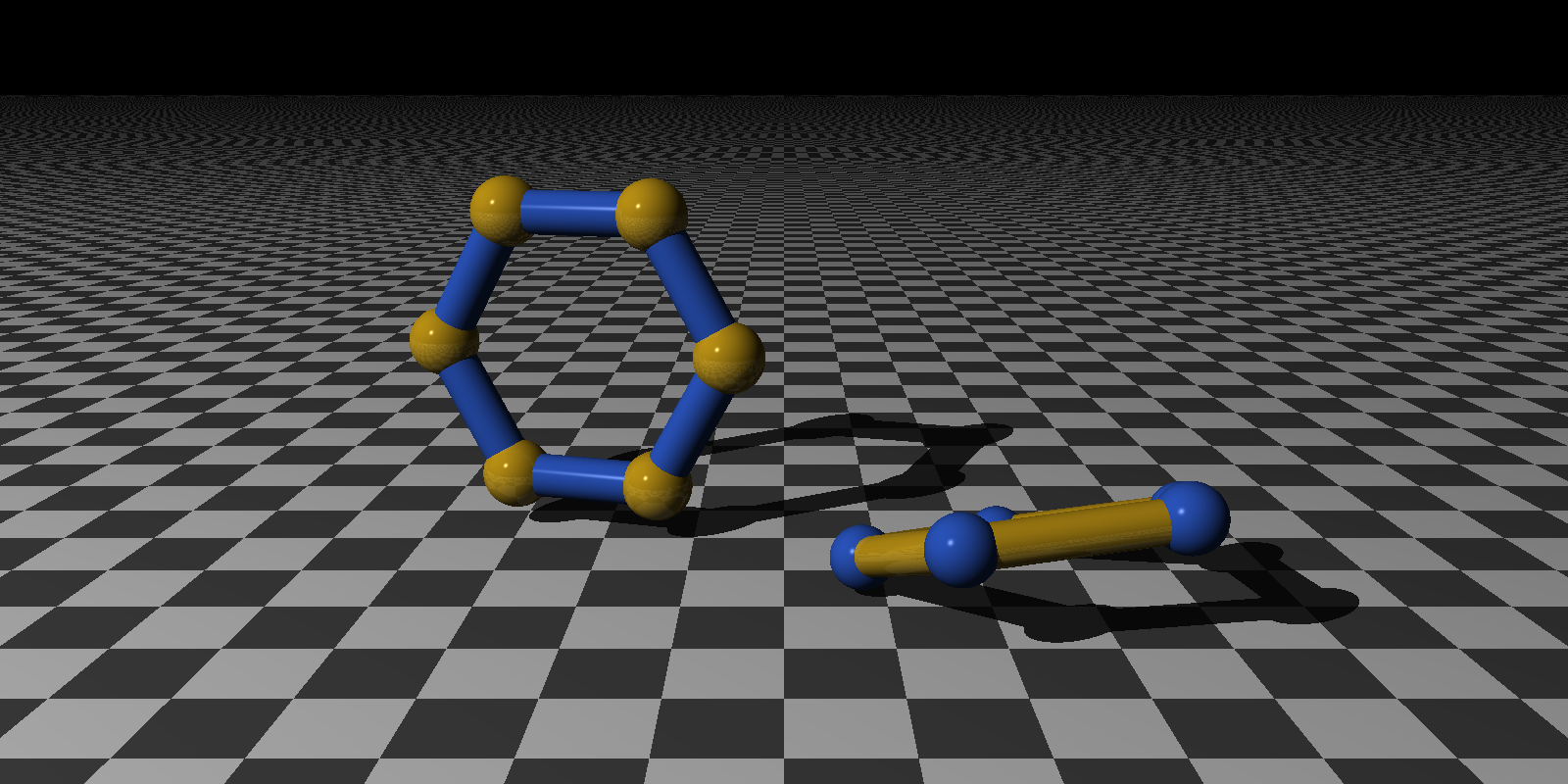
polygon_frame(n, ...) makes a frame for any regular polygon: a ball at each corner and
a rod to the next corner, each rod a unit cylinder stretched to the length of a side,
laid along x and turned to point at the next corner, all in one group. The frame is then
a single shape: one transform stands it up, turns it and moves it. A hexagon frame
stands upright with gold balls and steel rods; a pentagon frame with the colours swapped
leans back beside it, on a checkered floor.
# a frame of n rods and n balls round a regular polygon of the given radius, lying in the
# x-z plane about the y axis: ball k at angle 2 pi k / n, a rod of radius `rod` from each
# ball to the next (a cylinder from y = 0 to 1, stretched to the rod's length, laid along
# x, then turned to point from one corner to the next), each ball and rod its own child
make a function called polygon_frame takes n, radius, rod, corner_m, rod_m returns g
  let g = group()
  let k = 0
  while k < n do
    let a0 = 2 * pi() * k / n
    let a1 = 2 * pi() * (k + 1) / n
    let x0 = radius * cos(a0)
    let z0 = radius * sin(a0)
    let dx = radius * cos(a1) - x0
    let dz = radius * sin(a1) - z0
    let len = sqrt(dx * dx + dz * dz)
    let ball = set_material(set_transform(sphere(), mat_mul(translation(x0, 0, z0), scaling(rod * (8/5), rod * (8/5), rod * (8/5)))), corner_m)
    let along = mat_mul(translation(x0, 0, z0), mat_mul(rotation_y(0 - atan2(dz, dx)), mat_mul(rotation_z(0 - pi() / 2), scaling(rod, len, rod))))
    let bar = set_material(set_transform(with_limits(cylinder(), 0, 1), along), rod_m)
    let g = add_child(add_child(g, ball), bar)
    let k = k + 1
  end
  return g
end

# a hexagon frame standing up and a pentagon frame leaning back, on a checkered floor
make a function called build_hexagon_scene returns w
  let floor_m = with_pattern(material_with(color(1, 1, 1), (1/10), (9/10), 0, 200), set_pattern_transform(checkers_pattern(color((9/10), (9/10), (9/10)), color((3/10), (3/10), (3/10))), scaling((1/2), (1/2), (1/2))))
  let floor_p = set_material(plane(), floor_m)
  let gold = with_reflective(material_with(color((9/10), (7/10), (1/10)), (1/10), (7/10), (6/10), 200), (1/10))
  let steel = material_with(color((2/10), (4/10), (9/10)), (1/10), (7/10), (4/10), 100)
  let hex = set_transform(polygon_frame(6, (17/20), (3/25), gold, steel), mat_mul(translation(-(11/10), (21/20), (3/5)), mat_mul(rotation_y((3/10)), rotation_x(pi() / 2))))
  let pent = set_transform(polygon_frame(5, (17/20), (1/10), steel, gold), mat_mul(translation((6/5), (9/25), -(1/2)), mat_mul(rotation_y(-(2/5)), rotation_x((7/20)))))
  return [[floor_p, hex, pent], demo_light(), true]
end
# Chapter 14, "Putting It Together": a hexagon built from groups -- sides of one
# sphere and one cylinder, rotated into a ring, with a smaller hexagon nested inside.
include "../lib/spec.patlang"
include "../lib/png.patlang"
include "../lib/camera.patlang"
include "../lib/demo_scene.patlang"

let w = build_hexagon_scene()
let cam = set_camera_transform(camera(400, 200, pi() / 3), view_transform(point(0, (12/5), -(13/2)), point(0, (9/10), (1/5)), vector(0, 1, 0)))
render_example(cam, w, "../out/ch14_hexagon.png")
> tools/prender.sh examples/ch14_hexagon.patlang
assembled 400x200 from 40 bands
rendered with 9 parallel processes (40 bands) in 265 s wall clock
Checking it independently
The recursive tracer learned the frames by flattening them: each of the 22 leaves gets the product of its chain of transformations, so no group code is involved, and its normal is the transpose of the inverse of that product. Every second pixel in each direction:
> powershell.exe -NoProfile -File tools/verify_recursive.ps1 out/ch14_hexagon.png -Scene hexagon -Stride 2
decoded by .NET: 400x200; pixels differing from the independent recursive tracer by more than 1 level: 0 (max difference 0); stride 2 in each direction, 20000 pixels checked
Negative control: the same tracer against the Boxes, cylinders and cones image, which it should reject.
> powershell.exe -NoProfile -File tools/verify_recursive.ps1 out/ch13_cylinders.png -Scene hexagon -Stride 4
decoded by .NET: 400x200; pixels differing from the independent recursive tracer by more than 1 level: 3614 (max difference 190); stride 4 in each direction, 5000 pixels checked
Step 5 — what the boxes buy
A floor and n × n bags of nine marbles each, rendered at 80×40 with the boxes on
and off by tools/bench_bounds.sh (every run its own process, ten at a time, so
the absolute times include some contention). The last column compares a checksum of
all the pixel bytes: the picture is identical either way.
 marbles    boxes off     boxes on   speedup  box tests bags entered same image
      36     47774 ms     16445 ms     2.91x      25600          839        yes
      81     80499 ms     21791 ms     3.69x      57600          718        yes
     144    119446 ms     29307 ms     4.08x     102400          739        yes
     324    214781 ms     47961 ms     4.48x     230400          652        yes
     576    358052 ms     70099 ms     5.11x     409600          683        yes
With the boxes off, every ray tests every marble, so the time grows with the marble count (less than linearly overall, since the floor and the fixed work do not grow). With them on, a ray tests each bag's box and only the few bags it passes through, so the cost follows the number of bags, and the gain widens with the scene: 2.9× at 36 marbles, 5.1× at 576. Each bag holds only nine spheres, so a skipped bag saves nine sphere tests for the price of one box test; larger groups would gain more..
A Bounding-Volume Hierarchy
Groups and trees of boxes gave every group a box, and the performance page saw what that buys: a ray
that misses the box skips the whole group. Inside the box, though, a group still tries every
child. For a mesh of n triangles that is n triangle tests per ray, and it shows: a ray
through a sphere of 12 600 triangles costs a tenth of a second.
The fix is the same idea applied again, to the inside of the group. Put a box round each child; put a box round each pair of neighbouring boxes; and so on up to one box round the lot. A ray walks down from the top, and wherever it misses a box it skips everything below it. A mesh then costs a handful of triangle tests per ray, however large.the tree is a spatial index for the children
The rule: no picture may change
The performance page's rule stands. The tree only decides which children to try; the
children it picks are put back into their own order and tried exactly as the linear loop
tries them, so the list of hits is identical — the same t, to the last bit, in the same
order, ties included. The tests below compare hit lists, not pictures, against the plain
linear loop, which is kept as the oracle.
The tree
A node is [box, left, right]; a leaf, holding up to four children, is [box, indices].
A node is built by sorting its children along the longest side of its box, by the middle
of each child's box, and cutting the list in half. Children with no finite box, such as a
plane, cannot be put in a tree and sit in a short list of their own, tried every time.
A box is padded by a ten-millionth of its coordinates. A ray that touches a triangle at the very edge of a box can be called a miss by the slab test and a hit by the triangle test, because the two round differently, and losing that hit would change a picture. The padding costs nothing measurable and rules the case out.
group_with_bvh builds trees for a group and for every group inside it, and leaves groups of
fewer than 8 children alone: the walk costs more than it saves there. world_bounded calls
it on every top-level group, so render and render_band get the trees without a change to
any scene.
# the boxes' two corners as lists, padded
make a function called bvh_pad takes b returns padded
  let lo = []
  let hi = []
  let k = 0
  while k < 3 do
    let lo = list_push(lo, b[0][k] - (1/10000000) * (1 + abs(b[0][k])))
    let hi = list_push(hi, b[1][k] + (1/10000000) * (1 + abs(b[1][k])))
    let k = k + 1
  end
  return [lo, hi]
end

make a function called bvh_finite takes b returns yes
  if b == false then
    return false
  end
  let k = 0
  while k < 3 do
    if abs(b[0][k]) >= infinity() or abs(b[1][k]) >= infinity() then
      return false
    end
    let k = k + 1
  end
  return true
end

# a stable merge sort of [key, index] pairs, by key and then index
make a function called sort_pairs takes items returns sorted
  if items.length <= 1 then
    return items
  end
  let mid = floor(items.length / 2)
  let left = []
  let right = []
  let i = 0
  while i < items.length do
    if i < mid then
      let left = list_push(left, items[i])
    else
      let right = list_push(right, items[i])
    end
    let i = i + 1
  end
  let a = sort_pairs(left)
  let b = sort_pairs(right)
  let out = []
  let i = 0
  let j = 0
  while i < a.length or j < b.length do
    if j >= b.length or (i < a.length and (a[i][0] < b[j][0] or (a[i][0] == b[j][0] and a[i][1] <= b[j][1]))) then
      let out = list_push(out, a[i])
      let i = i + 1
    else
      let out = list_push(out, b[j])
      let j = j + 1
    end
  end
  return out
end

# the tree over the children `items` (indices), whose padded boxes are boxes[index]
make a function called bvh_build takes items, boxes returns node
  let box = false
  let k = 0
  while k < items.length do
    let box = bounds_union(box, boxes[items[k]])
    let k = k + 1
  end
  if items.length <= 4 then
    return [box, items]
  end
  # split at the middle of the children sorted along the longest side of the box
  let axis = 0
  let best = box[1][0] - box[0][0]
  let a = 1
  while a < 3 do
    if box[1][a] - box[0][a] > best then
      let best = box[1][a] - box[0][a]
      let axis = a
    end
    let a = a + 1
  end
  let keyed = []
  let k = 0
  while k < items.length do
    let b = boxes[items[k]]
    let keyed = list_push(keyed, [b[0][axis] + b[1][axis], items[k]])
    let k = k + 1
  end
  let sorted = sort_pairs(keyed)
  let mid = floor(sorted.length / 2)
  let left = []
  let right = []
  let k = 0
  while k < sorted.length do
    if k < mid then
      let left = list_push(left, sorted[k][1])
    else
      let right = list_push(right, sorted[k][1])
    end
    let k = k + 1
  end
  return [box, bvh_build(left, boxes), bvh_build(right, boxes)]
end

# the group with a tree (and so does every group inside it); groups of fewer than 8 children
# are left as they are
make a function called group_with_bvh takes g returns g2
  let params = g[6]
  let kids = []
  let k = 0
  while k < params[0].length do
    let kid = params[0][k]
    if kid[5] == "group" then
      let kid = group_with_bvh(kid)
    end
    let kids = list_push(kids, kid)
    let k = k + 1
  end
  if kids.length < 8 then
    return list_set(g, 6, [kids, params[1]])
  end
  let boxes = []
  let items = []
  let always = []
  let k = 0
  while k < kids.length do
    let b = parent_space_bounds(kids[k])
    if bvh_finite(b) then
      let boxes = list_push(boxes, bvh_pad(b))
      let items = list_push(items, k)
    else
      let boxes = list_push(boxes, false)
      let always = list_push(always, k)
    end
    let k = k + 1
  end
  let tree = false
  if items.length > 0 then
    let tree = bvh_build(items, boxes)
  end
  return list_set(g, 6, [kids, params[1], [tree, always]])
end

# the indices of the children under the nodes the ray reaches, appended to out
make a function called bvh_walk takes node, r, out returns found
  if not box_hit(node[0], r) then
    return out
  end
  if node.length == 2 then
    let found = out
    let k = 0
    while k < node[1].length do
      let found = list_push(found, [node[1][k], 0])
      let k = k + 1
    end
    return found
  end
  return bvh_walk(node[2], r, bvh_walk(node[1], r, out))
end

# the children to try for this ray, in the children's own order
make a function called bvh_candidates takes tree, r returns order
  let found = []
  if tree[0] != false then
    let found = bvh_walk(tree[0], r, [])
  end
  let k = 0
  while k < tree[1].length do
    let found = list_push(found, [tree[1][k], 0])
    let k = k + 1
  end
  return sort_pairs(found)
end
The group's own intersection is the old loop with one change: if the group has a tree, it loops over the candidates in the order the tree gives them rather than over all the children.
make a function called group_local_intersect takes g, r returns xs
  let params = g[6]
  let kids = params[0]
  if kids.length == 0 then
    return []
  end
  if bounds_on(g) then
    count_work(g, "box_tests", 1)
    if not box_hit(params[1], r) then
      return []
    end
  end
  count_work(g, "groups_entered", 1)
  let frame = group_frame(g)
  let xs = []
  # a group with a tree tries only the children the ray can reach, in their own order
  let order = false
  let tried = kids.length
  if params.length > 2 then
    let order = bvh_candidates(params[2], r)
    let tried = order.length
  end
  count_work(g, "children_tested", tried)
  let k = 0
  while k < tried do
    let which = k
    if order != false then
      let which = order[k][0]
    end
    let hs = intersect(kids[which], r)
    let j = 0
    while j < hs.length do
      let xs = list_push(xs, list_set(hs[j], 1, attach_outer(hs[j][1], frame)))
      let j = j + 1
    end
    let k = k + 1
  end
  return intersections(xs)
end
Scenarios and oracles
- The tree is a tree. Every child is in it exactly once; every box contains the boxes below it; leaves hold at most four children; a group of two children gets no tree.
- The same answers. For a sphere of 396 triangles and 306 rays — hits, misses, rays that start inside, rays along an axis, rays that graze the poles — the group with a tree returns exactly the hits of the group without one, in the same order. The same under a transformation of the whole group.
- Ties. Ten identical triangles all hit at the same
t; they come back in the children's order with and without the tree. - A plane among the triangles is kept out of the tree and still found.
- Nested groups each get a tree, and the hits still match.
- The saving. A ray through 720 triangles tries all 720 in the linear loop and only a handful with the tree.
- Negative control: a tree with its leaves emptied loses hits on most of 200 rays.
What it costs, at four sizes and more
Doubling the mesh should double the cost of the linear loop, and barely move the tree's.
It also costs something to build: sorting is n log n.
> v2_interp.exe examples/ch23_bvh_bench.patlang
182 triangles: linear 53130 us a ray, tree 7450 us a ray (7.1x), tree built in 592 ms
396 triangles: linear 114810 us a ray, tree 8910 us a ray (12.8x), tree built in 1371 ms
750 triangles: linear 215750 us a ray, tree 9320 us a ray (23.1x), tree built in 3019 ms
1564 triangles: linear 400350 us a ray, tree 7720 us a ray (51.8x), tree built in 6417 ms
3100 triangles: linear 912440 us a ray, tree 9620 us a ray (94.8x), tree built in 9373 ms
6392 triangles: linear 1918850 us a ray, tree 9270 us a ray (206.9x), tree built in 31750 ms
12600 triangles: linear 3567060 us a ray, tree 9870 us a ray (361.4x), tree built in 68908 ms
The linear column doubles with each doubling of n; the tree's grows by about a tenth of
its previous value for each doubling, which is log n. The tree is built once per process;
a parallel render builds it once per band, so the build time is part of every band's
start-up (about 1.7 s at 6 400 triangles).
Nothing changed
The benchmark suite's pictures are byte-identical (its mesh scene, two spheres of about a hundred faces, goes from 3.9 s to 1.4 s), and so is the full-size picture of Triangles and meshes from files, rendered with trees:
> tools/prender.sh examples/ch15_meshes.patlang
assembled 400x200 from 40 bands
rendered with 9 parallel processes (40 bands) in 1210 s wall clock
> cmp out/ch15_meshes.png docs/img/ch15_meshes.png && echo "the PNG is byte-identical to the one in [Triangles and meshes from files](15-meshes.md)"
the PNG is byte-identical to the one in [Triangles and meshes from files](15-meshes.md)
How it is checked
> v2_interp.exe tests/run.patlang --node shapes/groups --depth 2
[ ok ] Groups of shapes
[ ok ]   An empty group is hit by nothing
[ ok ]   A group is hit wherever its children are, in order of t
[ ok ]   A group's transform carries its children
[ ok ]   A group of three overlapping shapes: every part of every surface
[ ok ]     Every hit lies on the surface
[ ok ]     No crossing of the surface is missed
[ ok ]     Normals follow the gradient of the surface's function
[ ok ]   Groups in a turned, stretched group
[ ok ]     Every hit lies on the surface
[ ok ]     No crossing of the surface is missed
[ ok ]     Normals follow the gradient of the surface's function
[ ok ]   A group's bounding box holds every hit on its children
[ ok ]   Three ways to search a group  (all, giving the same answer)
[ ok ]     naive: try every child, no boxes
[ ok ]     faster: skip a child whose box the ray misses
[ ok ]     fastest for many children: a tree of boxes
[ ok ]   A tree of boxes for big groups
[ ok ]     The tree
[ ok ]     The same answers
[ ok ]     The saving
[ ok ]   Further checks, independent of the code they check
[ ok ]     A sphere two groups deep: same t as the product transform
[ ok ]     A pattern on a shape in a group sees the group's transformation
[ ok ]     A sphere's bounds: -1 to 1
[ ok ]     Ray/box agrees with the slab method on coordinates
[ ok ]     Boxes on = boxes off: the same ts and shapes for all
[ ok ]     A world with a box for each object finds exactly the intersections and shadows of the same world without them, on rays from inside and outside (negative t included)
checks: 26 passed, 0 failed, 0 blocked, 0 skipped, 0 not run
ALL PASSED
> v2_interp.exe tests/run.patlang --node shapes/bounds --depth 2
[ ok ] Bounding boxes
[ ok ]   Each shape's own box
[ ok ]   A transformed box holds the transformed corners of the original
[ ok ]   The union of two boxes holds both
checks: 3 passed, 0 failed, 0 blocked, 0 skipped, 0 not run
ALL PASSED