Last updated: 2026-11-16
Deep Field Engineering Lab
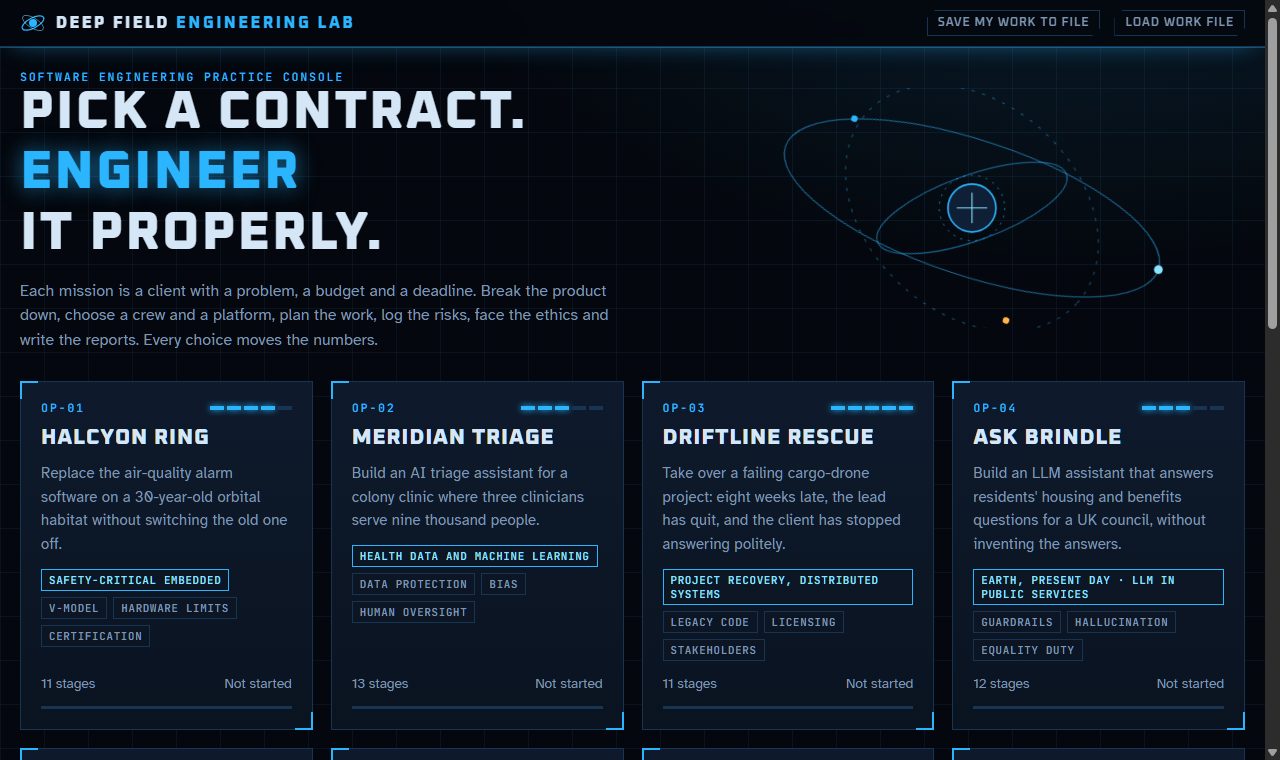
Twelve client contracts, each with a budget, a deadline and a problem that doesn't fit neatly into a lecture. The Deep Field Engineering Lab is a browser-based practice console for the parts of software engineering that are hard to rehearse on a toy project: breaking a product down, choosing a team, planning around dependencies, logging risks, making ethical commitments and writing the reports someone else will have to trust.
How a Mission Runs
Every mission opens with a briefing: the client, what they need, the constraints, and a table of the people who care about the outcome. From there you work through a sequence of stages, in any order, each one practising a single skill.
| Stage | What you do |
|---|---|
| Product breakdown | Repair a Mermaid diagram of what will exist when the project finishes. The starter version mixes deliverables with activities and leaves out products a client or regulator will expect. |
| Decisions | Choose a delivery approach, a platform, or a set of ethical and legal commitments. Consequences stay hidden until you commit; afterwards the feedback for every option is shown, including the ones you didn't take. |
| Crew selection | Pick a crew of the size the mission allows from a roster of personas. Each has a weekly rate, skill levels and a trait the lead will have to manage. |
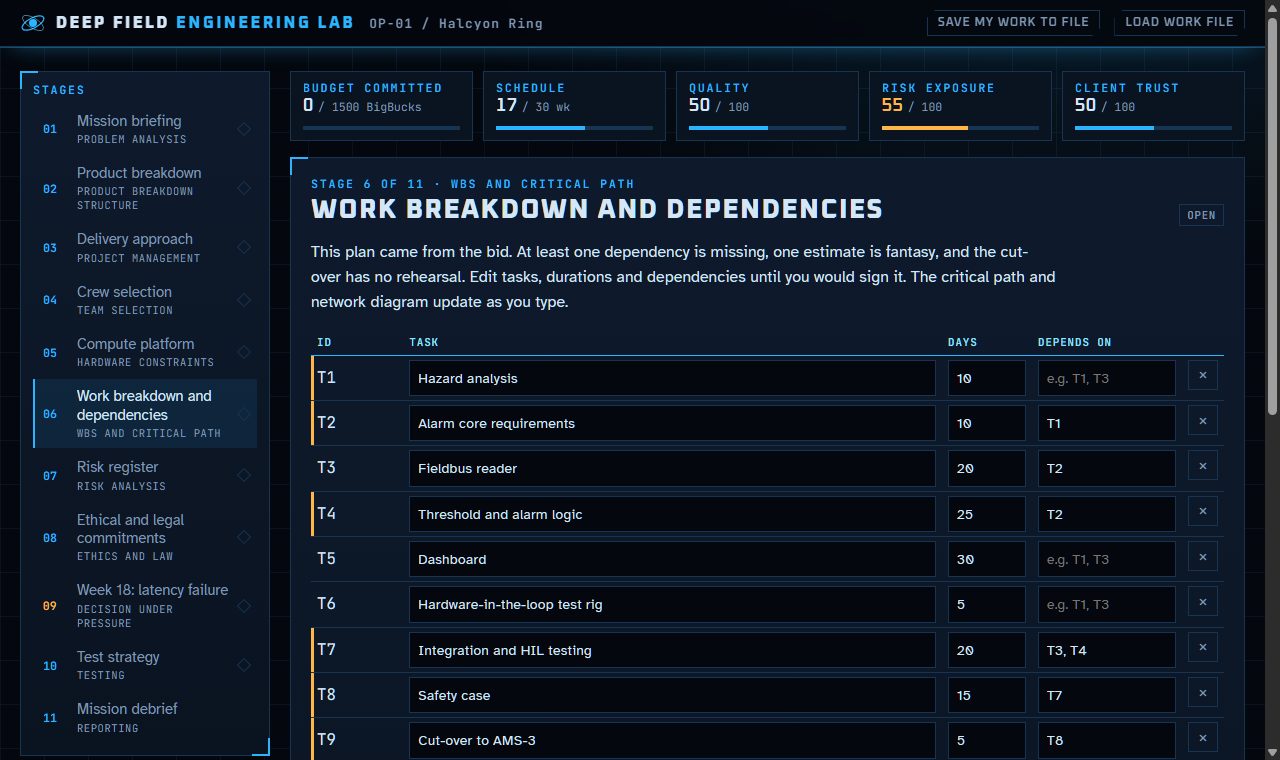
| Work breakdown | Edit a task plan inherited from the bid. The critical path, slack and network diagram are recalculated as you type, and circular or missing dependencies are reported. |
| Risk register | Log risks with likelihood, impact, response and mitigation, see them on a matrix, then compare your register with the one the mission's auditor wrote. |
| Unplanned event | Something goes wrong partway through the project. In Halcyon Ring, a week-18 rig test shows the alarm missing its two-second deadline, and the options include telling the client, cutting scope and reporting green while fixing it quietly. |
| Written deliverables | Draft a test strategy, a data protection impact assessment, a status report to the client or a similar document in Markdown with a live preview and a minimum word count. |
| Debrief | See the final scores and a full mission report in Markdown, ready to download and hand to a peer or tutor. |
The Missions
The contracts range from safety-critical control systems to present-day AI products under real regulatory pressure. Difficulty varies, and so does the kind of trouble each one is built around.
| Mission | Domain | The contract |
|---|---|---|
| Halcyon Ring | Safety-critical embedded | Replace the air-quality alarm software on a 30-year-old orbital habitat without switching the old one off. |
| Meridian Triage | Health data and machine learning | Build an AI triage assistant for a colony clinic where three clinicians serve nine thousand people. |
| Driftline Rescue | Project recovery | Take over a cargo-drone project that is eight weeks late, after its lead has quit. |
| Ask Brindle | LLM in public services | Build an assistant that answers residents' housing and benefits questions for a UK council without inventing the answers. |
| Turnstile | Facial recognition | A football club wants face recognition at the gates. Decide what to build, what to refuse, and how to show it treats every fan the same. |
| Shortlist | Cross-border AI regulation | Ship an LLM hiring-screening product to customers in London, Munich and New York, under three sets of rules that don't agree. |
| Tidewall | Hard real-time control | Write the control software for a storm-surge barrier with ten steel gates and a 50-millisecond control loop. |
| Deep Listen | Scientific data analysis | Turn a tangle of analysis scripts into a pipeline that can back a discovery claim from a radio array on the far side of the Moon. |
| Emberfall Online | Live-service games | Launch a massively multiplayer game to 400,000 pre-registered players without breaking the servers, the in-game economy or the team. |
| Nacelle VR | VR training | Build a virtual-reality course for wind-turbine technicians doing high-voltage work 110 metres up, and show that it trains them. |
| PatLang | Programming language engineering | Take a self-hosted language written by AI agents from one maintainer's experiment to something outside users can depend on. |
| Open Atlas | Knowledge site and content pipeline | Engineer a teaching and research website of 600 linked pages with references a reader can trust. |
How the Numbers Move
Five meters run across the top of every mission: budget, schedule, quality, risk exposure and client trust. Budget is the crew's weekly rates over the contract length, plus the cost of each committed decision. Schedule comes from the critical path of your plan at five working days a week, adjusted by decisions that add or save time. Quality, risk and trust start at the mission's own values and shift with each choice, with crew skills that cover the mission's needs, and with every risk logged against a mitigation someone could act on.risk exposure tracks what's left
Written work and diagrams aren't marked automatically. Each of those stages has a short self-review checklist, and the debrief report collects everything into one Markdown document, with a space after each decision for your justification. That justification is where most of the learning sits: two students can make the same choice for very different reasons.
Using It in a Class
For a seminar, give each group one mission and ask them to bring the downloaded report. Comparing two groups' decisions on the same unplanned event usually produces a better discussion than any single right answer would.
Tutors can write their own missions. The Add a mission card on the home screen offers a blank template and a copy of any built-in mission as a JSON file. A mission is a header (client, brief, budget, deadline) and an ordered list of stages, with Markdown and Mermaid diagrams allowed in the text. An uploaded mission is stored only in the browser it was added to, so the way to give it to a class is to share the file.JSON is plain text. Share via email or LMS.
Nothing typed into the lab is sent anywhere. Saving, loading and report downloads all happen on your own machine.
Keyboard and Screen Reader Use
Every stage can be completed with a keyboard alone. Moving between stages takes focus to the new stage's heading, focus stays on an option after it's chosen, and adding or deleting a task or risk moves focus to the row you'd expect to edit next. Status messages are announced to screen readers, and the layout reflows to a single column on a phone. The console uses a single dark theme, with body text set in Atkinson Hyperlegible.
Related Pages
- Risk Register Template: the columns the lab's register stage uses, with guidance on writing each one.
- The V Model, with a Third V for Values: background for the Halcyon Ring mission, whose delivery-approach decision weighs a V-model against iterative and hybrid lifecycles.
- Product and Ethical Risk: the questions behind the ethics stages, about whether a product should be built at all.
- Disciplined Personas: useful when writing a crew roster or stakeholder table for a mission of your own.
Graduate Attributes
Directly developed
- Critical Thinker: Readers provide written justifications for their decisions to explain the reasoning behind specific choices.
- Collaborative: Readers compare group decisions on unplanned events to evaluate different approaches to the same problem.
Modelled on this page
- Digitally Fluent: Data handling is described as local to the user machine to ensure privacy and control over information.
- Inclusive: The interface supports keyboard navigation and screen readers while using high-contrast typography for readability.
- Subject Specialist: Scenarios incorporate real-world constraints such as regulatory pressure and safety-critical requirements.
University of Reading Graduate Attributes framework.